Category Landing
Decorative Antique Books for Shelves, Events, and Installations
French hardbacks sourced in the Dordogne — patinated linens, leather spines, gilt titles, and cohesive colour palettes ready for styling or gifting.
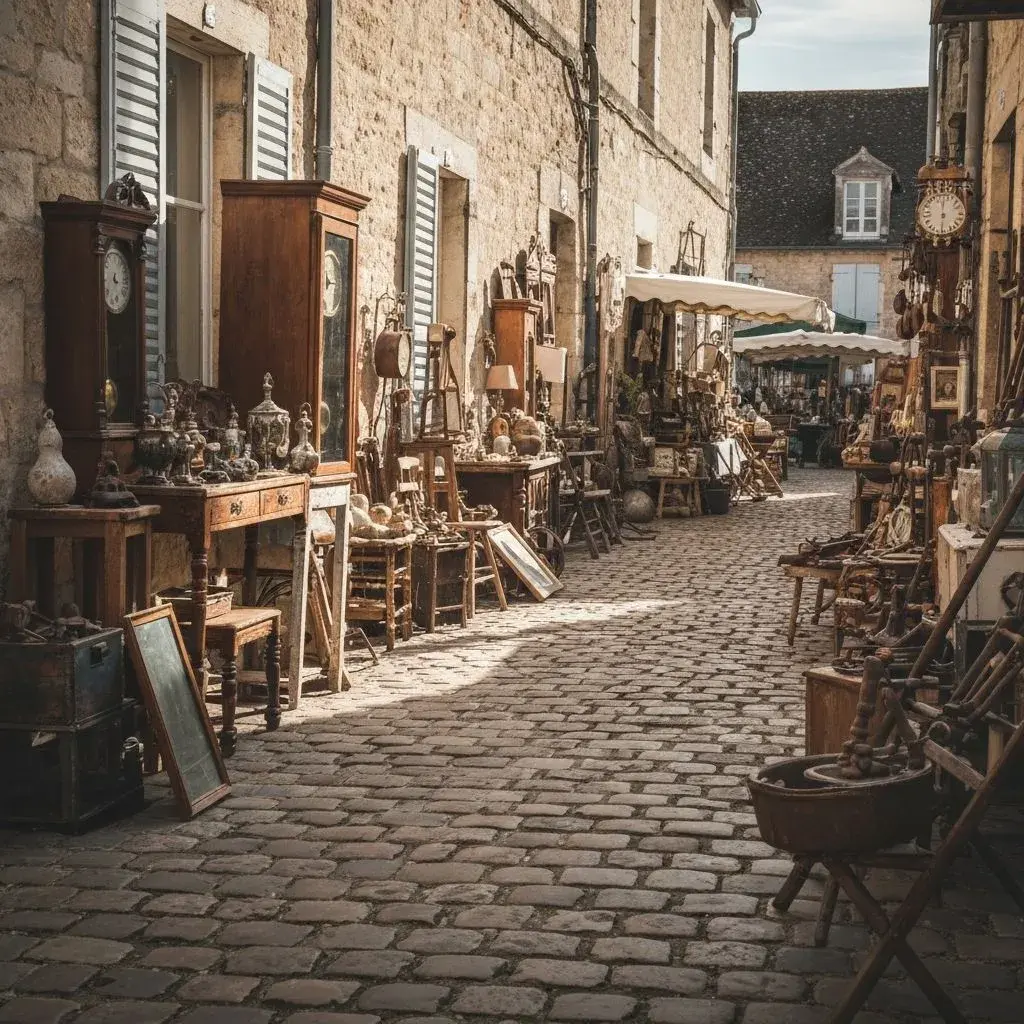
For interiors
Neutral shelf runs
Linen and vellum spines in warm creams, taupes, and sage. Perfect for built-ins, hotel lobbies, coffee shops, and home staging.
For events
Wedding and restaurant vignettes
Petite poetry books and gilt classics sized for centrepieces, bar shelves, photo tables, and retail displays. I can match palette and height.
For collectors
Statement single volumes
Leather-bound Balzac, illustrated travelogues, and children’s tales with engravings. Each photographed with spine heights and close-ups.
What to expect
- Palette-based pulls: earthy neutrals, moody jewel tones, or mixed vintage leathers on request.
- Transparent condition notes: foxing, soft corners, and patina documented so remote buyers can decide fast.
- Bulk options: runs by metre or by count; I share preview photos before shipping larger sets.
- Shipping worldwide from France with protective wrapping; tracked via Etsy checkout.
Need a custom set?
Send a palette, height range, and quantity. I’ll build a cohesive run and photograph it for approval before you buy. Designers, architects, restaurants, and wedding planners welcome. Once on Etsy, tap “Contact shop owner” to send your request.
Shop decorative antique books
Live listings update automatically from Etsy. Styles range from linen-cloth novels to gilt leather sets.
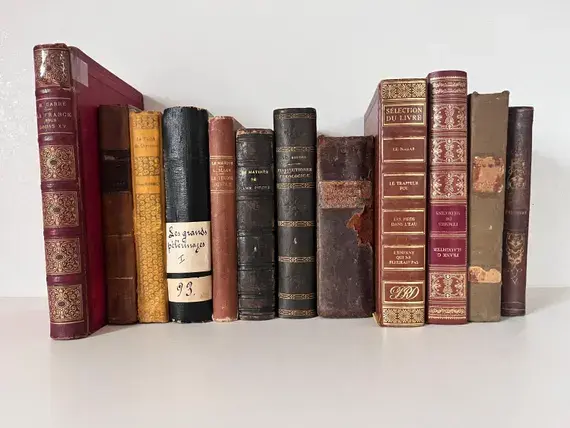
Very Old French Decorative Book | Shabby Patina | Book Lover Gift | Antique Decor
8.00 EUR
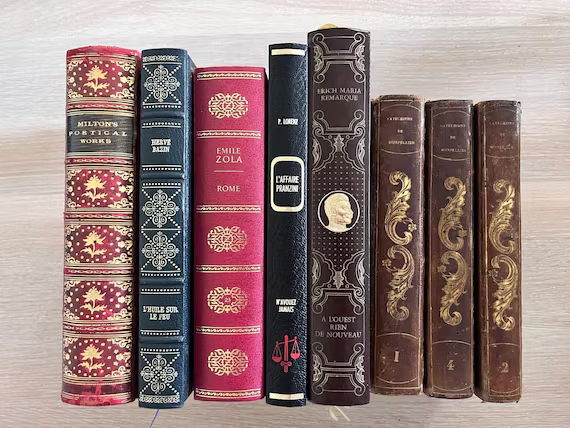
French Decorative Book | Leather & Fabric Bound | Bookshelf Decor | Choose Your Colour
5.99 EUR

Vintage CHANEL Press Kit 1996-1997 Cruise Collection Fashion Photo Archive Lapidus Lanvin Scherrer Guy Laroche Expert Authenticated Paris Co
220.00 EUR
Bindings
How to read a French binding
Once you know what you are looking at, a shelf of French books stops being a wall of old spines and starts telling you where each volume came from. This is roughly what goes through my head at a market stall.
Percaline cloth
The glazed cotton used on 19th-century French bindings, and the reason the colours are so deep — oxblood, moss, ochre, and inky blue that have held their tone for a century.
Demi-reliure
Half binding: a leather spine and corners with marbled paper boards. The marbling was combed by hand, so no two are identical, and a shelf of them reads as collected rather than bought.
Livres de prix
School prize books, with a gilt cartouche stamped on the front board and a printed label pasted inside naming a pupil, a school, and a year. Often the easiest way to date a book whose title page never carried one.
Imprints and dates
Hachette, Garnier Frères, Calmann-Lévy, Flammarion, Larousse, Nelson. When the title page has no date, the achevé d’imprimer line at the back of the book usually gives the month it was actually printed.
Gilt is worth a second look too. Genuine gold tooling stays warm and slightly uneven under raking light, catching differently along the ridges of the spine, where later stamped foil tends to sit flat and bright. Neither is better for styling — but only one of them explains why a book from 1890 still looks expensive on a shelf.
What I check before a book joins a set
- Hinges first: open the board and look down into the gutter. A cracked hinge means the board will part company eventually — fine in a decorative stack, wrong for a book that will be handled.
- Head and tail of the spine, the two places that chip first, usually from being pulled off a shelf by the top edge for a hundred years.
- The text block held by its boards alone: a book that sags open in the middle is starting to split its sewing.
- Foxing against damp. Freckled pages are age and I leave them be; cockled paper and a dark tide line are water, and those I put back down.
- Smell, honestly. Mildew never leaves a book, so a musty volume does not go in a box bound for anyone’s shelf.
- Spine height, measured and recorded for every volume, because that single number decides whether a run lines up on your shelf or steps up and down like a skyline.
Pricing
What books cost at the brocante
Ordinary French hardbacks go for a euro or two at a village vide-grenier, and by the last hour of the day they often go by the crate. Leather sets, illustrated volumes, and anything with engravings are dealer-priced and climb steeply.
Colour is what actually costs. A crate of fifty books might hold six in the same warm ochre, which is why a palette-matched metre of spines is priced differently from fifty random books — you are buying the six, not the fifty.
Packing
How sets travel
Books are wrapped in paper so cloth cannot rub against cloth, cushioned at the corners, and boxed tightly enough that nothing shifts in transit — a loose book in a big box arrives with a bruised spine. Larger runs are split across boxes to keep weight sensible, and everything ships tracked through Etsy.
FAQ
Can I request titles or genres?
Yes. Literature, history, philosophy, travel, and children’s illustrated books are common. I match by look first, then by subject if you want readable sets.
Do you rent sets?
I sell only, but I can assemble cost-effective runs for recurring event use so you can keep them in a prop library.
How are sets packed?
Wrapped in paper, cushioned, boxed tightly to prevent rub. Larger orders may be split into multiple boxes to protect spines and keep weight manageable.
Returns?
Most orders can be returned; message within 14 days of delivery. Buyer pays return shipping unless the item arrived damaged.